
Chain Link Fence Lifespan in High-Desert Wind: What Lasts in Reno and Sparks
If you have already decided on chain link and want it to hold up, the main question left is chain link fence lifespan. In Sparks and Reno, that answer depends less on the material itself and more on how the fence meets our specific conditions: high-desert wind off the valley, freeze-thaw cycles through Washoe County winters, and alkaline soil that works against anything buried in it. Chain link handles all three better than most materials, but only if the install matches the site. This guide walks through what actually determines how long a chain link fence lasts here, what fails first, and what to check during and after installation so you get the full life out of it.
Why Chain Link Holds Up in Reno and Sparks Wind
Chain link is an open mesh. Wind passes through it instead of pushing against it. That single fact explains most of its durability advantage in our area.
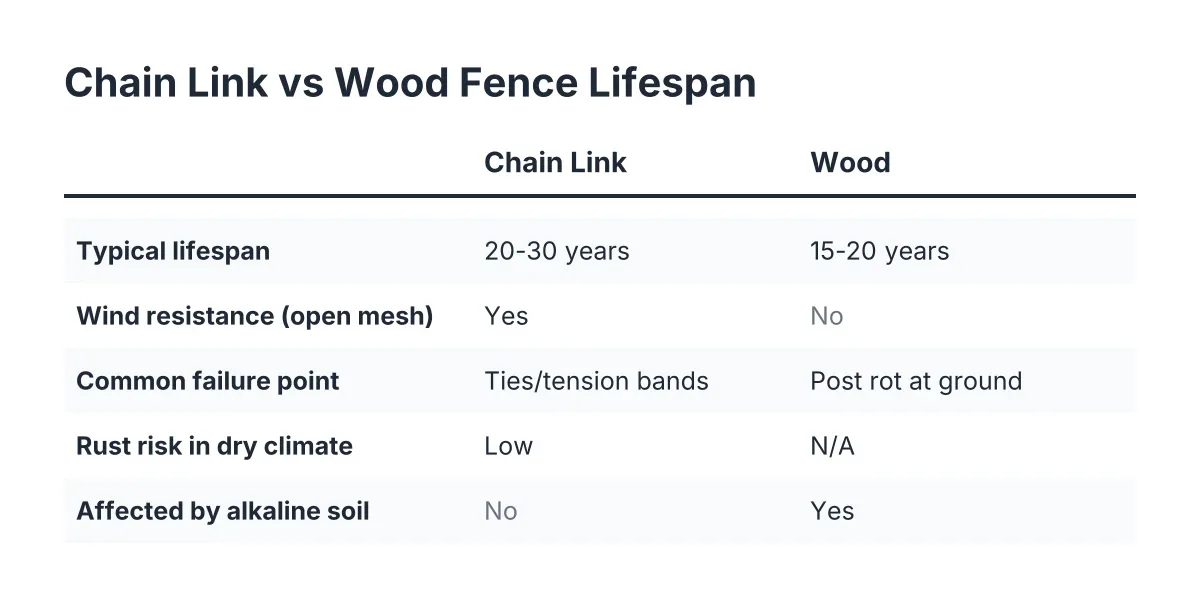
A solid wood privacy fence catches wind like a sail. Every gust loads the posts, works the rails, and loosens the fasteners. Over years, that constant flexing is what racks panels and snaps posts at the ground line. Here is the part that surprises people: a solid fence that blocks wind completely is often more likely to blow over in a high-wind area than a design that lets air pass through. Chain link takes that logic to its limit. Almost nothing for the wind to grab means almost nothing for the wind to break.
This is a real advantage on exposed lots. Think of the open subdivisions on the north edge of Sparks or the older ranch-style properties around Reno where there is no windbreak for half a mile. On those sites, wind exposure is the first thing worth evaluating before any fence goes in, and it is the main reason chain link keeps showing up on utility lots, schoolyards, and backyards alike. Nationally, chain link accounts for nearly 34% of total fencing demand in the United States, according to Global Growth Insights. It did not earn that share by being pretty. It earned it by staying standing.
What a Realistic Chain Link Fence Lifespan Looks Like
A galvanized chain link fence, installed correctly, commonly outlasts the homeowner's time in the house. Two to three decades is a reasonable expectation in a dry climate like ours, and the dry air works in your favor. Rust needs moisture. The high desert does not give it much.
Compare that to wood. Wood fences last about 15 years on average, up to 20 years, depending on wood type, climate, and pest exposure, according to Angi. In practice, the posts usually fail before the panels. A wood post rots at the ground line even when the boards above it have been repainted and maintained for years. Steel posts set in concrete do not have that failure mode. They can rust, but in our climate that process is slow, and a vinyl-coated or well-galvanized post slows it further.
Vinyl-coated chain link adds a plastic layer over the galvanized wire. The coating blocks moisture, resists UV fading in our intense high-altitude sun, and gives the fence a cleaner look in black or green. For a backyard fence that will take decades of sun exposure, the coating is worth considering. However, be honest about trade-offs: the coating can crack if the fabric gets bent hard, and no coating fixes a fence that was stretched or set poorly in the first place.
The dry summary: chain link fence lifespan in Washoe County is usually limited by the installation quality, not the material. The wire will outlast a bad install every time. That is why the rest of this guide focuses on the install itself.
The Three Local Conditions That Shorten Fence Life Here
Three site conditions do most of the damage to fences in Sparks and Reno. Each one has a specific answer during installation.
Freeze-thaw movement at the posts
Washoe County winters swing above and below freezing repeatedly. Water in the soil freezes, expands, and pushes on anything shallow. A post set in a shallow footing gets heaved a little each winter until it leans. Once one post leans, the fabric tension pulls the next post, and the lean spreads down the line.
The fix is depth and drainage. Posts need footings that reach below the frost movement zone, with concrete shaped so water sheds away from the steel instead of pooling against it. On a chain link fence, terminal posts, which are the corners, ends, and gate posts, carry the fabric tension, so they get the largest footings. If those are set right, the fence resists both frost heave and wind load for its full life.
Alkaline soil against buried steel
The soil around here runs alkaline, which affects both wood rot patterns and how buried metal ages. Galvanized steel in concrete handles it well, which is another point for chain link over wood posts in direct ground contact. The detail that matters is keeping the concrete crowned above grade so soil and water do not sit against the post at the surface, where corrosion starts first.
Sustained wind load on the framework
Wind mostly passes through chain link, but gusts still work the connection points. The weak links are the small parts: ties, tension bands, and rail ends. A fence tie bent the wrong way, so the wrap does not trap the fabric link against the pipe, stays loose enough that a hard gust can pop it open. One popped tie is cosmetic. A season of popped ties leaves the fabric sagging off the top rail, and a sagging fabric flaps, which accelerates wear everywhere else.
On a quality chain link fence installation, every tie gets bent so the wrap locks the fabric against the pipe, and the ties are sized to the actual pipe diameter, since ties come in different lengths for different pipe sizes. These are small details. They are also exactly the details that separate a fence that shrugs off a windstorm from one that needs a repair call after it.
Installation Decisions That Extend Chain Link Fence Lifespan
Since the install determines the lifespan, here is what to get right, whether you are doing it yourself or checking a crew's work. This is where the DIY-versus-hire question gets real: none of these steps is complicated, but every one of them is easy to shortcut, and the shortcuts do not show up for two or three years.
- Layout and line. Set string lines first and mark every post location. Crooked lines create uneven fabric tension, and uneven tension is where sags start.
- Terminal posts first. Corners, ends, and gate posts go in before line posts, in larger-diameter pipe with bigger footings, because they anchor all the pulling force in the fence.
- Footing depth and crown. Dig below the frost zone, set posts plumb in concrete, and crown the top of each footing so water runs off instead of pooling at the steel.
- Cure time. Let the concrete cure before stretching fabric. Pulling tension against green concrete rocks the posts loose, and they never fully tighten again.
- Rails and tension wire. Top rail ties the line posts together; bottom tension wire keeps the fabric from being pushed under by dogs, debris, or wind-blown tumbleweeds, which are not a joke out here.
- Stretch the fabric properly. The mesh gets pulled with a fence stretcher until it is tight and even, then attached to the terminal posts with tension bars and bands. Hand-tight is not tight. Loose fabric flexes in wind and wears out its own connections.
- Tie it right. Ties go on at regular spacing along the top rail and each line post, bent so the wrap traps the fabric against the pipe. A small technique note from the field: tying is easier standing on the side of the post opposite the mesh when access allows.
If you want the visual version of these steps, a chain link fence installation diagram or detail drawing shows the same anatomy: terminal posts with footings, line posts, top rail, tension bar, tension bands, tension wire, and ties. Knowing those part names also makes it much easier to describe a problem when you call about a repair.
There is one more lifespan trick specific to replacement jobs. Suppose a Sparks homeowner is replacing a failed wood fence and finds sound steel posts already set deep in old concrete. Reusing those existing taller steel posts and adding new posts between them can produce a tall fence that stands up to wind better than a typical fence of the same height built entirely from scratch. More anchoring per foot of fence means less load on each post. A local fence company that works in this wind will check for salvageable posts before quoting a full tear-out.
How Long Before a Chain Link Fence Needs Repair?
A well-installed chain link fence in the Reno and Sparks climate commonly goes a decade or more before it needs its first real repair, and many never need structural work at all. The first repairs are usually small: popped ties, a sagging gate, or fabric bent by an impact. Post and framework failures come later, and often trace back to an installation shortcut rather than age.
For the reactive situations, which is how most fence repair actually starts, here is what each symptom usually means:
- Leaning posts point to shallow footings, frost heave, or a vehicle or tree impact. One leaning terminal post will slowly pull the whole run out of line, so it is worth fixing early.
- Sagging fabric means ties have failed, the tension wire is broken, or the fabric was never stretched properly. Re-stretching a section is a routine repair, not a replacement.
- Bent top rail usually follows a falling branch or a snow-loaded tarp someone draped over the fence. Rail sections swap out individually.
- A dragging gate typically means the hinge hardware has worked loose or the gate post footing has moved. Both are fixable without touching the rest of the fence.
- Rust at the ground line is the slow one. Surface rust on galvanized wire is cosmetic for years. Rust that flakes and pits at post bases is the signal to evaluate the posts seriously.
The useful pattern: fabric and hardware problems are repairs; widespread post problems push toward replacement. If the damage is localized, say one section flattened by a backed-up truck or a run of popped ties after a windstorm, a repair restores the fence's original lifespan. Chain link is forgiving that way. Unlike a wood fence, where rot in one post usually means rot is coming in the others, chain link failures tend to stay where the impact happened.
As an illustrative scenario, say a homeowner off Pyramid Highway loses a 12-foot section when winter wind drives a neighbor's trampoline into it. Two bent line posts and a stretch of crumpled fabric. In that scenario, the repair is pulling the bent posts, setting two new ones in fresh concrete, letting it cure, splicing or replacing the fabric section, and re-tensioning. The rest of the fence is untouched, and the repaired section is as strong as the day the fence went in.
Chain Link Against Wood, Vinyl, and Wrought Iron in This Climate
For the researcher comparing materials before spending money, here is the honest matchup for high-desert conditions. Metal fencing, including chain link and wrought iron, held the largest share of the US fencing market at 56.4% in 2025, according to Grand View Research, and durability in harsh climates is a big part of why.
A wood fence gives privacy that chain link cannot, and a horizontal fence gives a modern look chain link never will. The costs of that are wind load on solid panels, posts that rot at the ground line, and boards that warp and twist in our dry air and temperature swings. Expect ongoing staining or sealing, and expect the posts to fail before the panels do.
Vinyl fence panels resist rot and fading better than wood, and they never need paint. The trade-offs are that a solid vinyl privacy panel still catches full wind load, and vinyl is still PVC, which matters in a region with real wildfire exposure. Steel wire does not burn; plastic panels can.
Wrought iron fence sits closest to chain link in the durability conversation. It is open to wind, strong, and long-lived with periodic rust maintenance. It costs considerably more per foot, which is why it tends to go on front yards and entries while chain link handles side yards, back perimeters, and dog runs.
One cost note that applies to every material: the cheapest quote is often the most expensive fence. Pricing differences between installers reflect construction practices, footing depth, pipe gauge, and expected longevity, not just materials and labor. A fence that has to be rebuilt in eight years costs more over time than one built right the first time, whichever material you chose. Because footing depth, local wind exposure, and HOA requirements vary lot by lot in Washoe County, it is worth having a professional look at the specific site before you commit to a layout, even if you plan to do some of the work yourself.
Getting the Full Life Out of It After Installation
Chain link asks for less upkeep than any other common fence, but less is not zero. A short routine protects the lifespan you paid for.
Walk the fence line each spring, after the worst of the freeze-thaw season and the winter windstorms. Push on each post; none should rock. Look for popped ties along the top rail and re-bend or replace them before the fabric starts to sag. Check gate hinges and latches, since gates take the most daily wear. Clear soil, mulch, or leaf litter that has built up against post bases, because trapped moisture at the ground line is where corrosion starts even in a dry climate.
That is the whole maintenance program. No staining, no sealing, no board replacement. If the fence was installed with deep crowned footings, properly stretched fabric, and correctly bent ties, that spring walk-through is usually all it takes to keep a chain link fence doing its job in Sparks and Reno wind for decades. The material was never the question. The install was, and now you know what to look for.
If you need chain link fence installation, Reno Sparks Fence Pros can help.
Prefer to talk it through? Call (775) 369-4729 — a quick call is usually the fastest way to get a straight answer for your situation.