
Decorative Wrought Iron Fence Panels: Styles, Sizing, and Custom Options Explained
Most people shopping for a decorative wrought iron fence start in the same place. They see one on a drive through an older Reno neighborhood, or an HOA board member spots the rusting pool fence in a reserve study, and the research begins. Then the confusion starts. Some pages call everything "wrought iron." Others say true wrought iron barely exists anymore. Panel sizes vary from site to site. Nobody explains what the custom options actually are or what they change about the price.
This guide sorts that out. We will walk through what decorative wrought iron fence panels actually are, the styles and toppers available, how panels are sized, where custom work makes sense, and when iron beats aluminum out here in Washoe County. By the end, you should be able to walk into a conversation with any local fence company already knowing what you want and why.
What "Wrought Iron" Means on a Modern Fence
First, a plain answer to the question most sites dodge. Almost every new "wrought iron fence" installed today is actually ornamental steel. True hand-forged wrought iron is a specialty product, mostly found on historic restorations and salvage pieces. Modern ornamental iron fencing uses steel pickets and rails welded or assembled into panels, then powder coated or painted.
That is not a downgrade. Steel panels give you the look people mean when they say decorative wrought iron fence: vertical pickets, finials, scrollwork, and an open design that shows off the yard instead of hiding it. The steel is strong, rigid, and heavy enough that it does not rattle in wind the way lighter metals can.
The name stuck because the look stuck. When a homeowner in Sparks searches for a wrought iron fence, what they want is that classic ornamental style, and that is what today's steel panels deliver. Some people also call it rod iron fencing; same product, different spelling that drifted into common use.
The market reflects how popular metal fencing has become. According to Grand View Research, metal fencing, including steel and ornamental types such as chain link and wrought iron, accounted for the largest share of the US fencing market at 56.4% in 2025. That demand means panel options have expanded, which is good news for anyone who wants something beyond a plain flat-top design.
Decorative Wrought Iron Fence Styles, from Plain to Ornate
Panel style is the first real decision, and it drives both the look and part of the cost. Ornamental wrought iron fence panels come in a handful of core designs, and most custom work is a variation on one of them.
The core panel designs
Here are the styles you will see most often, roughly in order from simplest to most ornate:
- Flat top. Pickets end flush with the top rail. Clean, modern, and the most common choice for pool enclosures and HOA perimeter fencing because there are no points to catch clothing.
- Spear top (extended picket). Pickets extend above the top rail and end in a point or finial. This is the classic ornamental look, and the points add a real security deterrent.
- Pressed point or staggered spear. Alternating picket heights create a rhythm along the top. It reads as more decorative without adding much cost.
- Arched or scalloped top. The top rail curves up or down between posts. This takes more fabrication work, so expect it to cost more than a straight run of the same height.
- Double top rail. A second horizontal rail near the top adds visual weight and stiffness. Common on commercial and community entrance fencing.
Decorative Iron Fence Panel Toppers, Finials, and Scrollwork
Decorative wrought iron fence toppers are where panels start to feel custom. Finials are the shaped tips on extended pickets: spears, fleur-de-lis, ball caps, and quad flares are the common ones. Rings, scroll inserts, and twisted pickets can be added between the rails as decorative pieces.
A practical note on toppers. Pointed finials look sharp and deter climbing, but they are the wrong choice around a pool or a play area. Pool fencing in particular has code requirements for height, picket spacing, and gate hardware, so flat-top panels dominate there for good reason. If an HOA is replacing pool fencing ahead of a compliance audit, the style decision is mostly made for them by code; the decorative choices live in the finish color and post caps.
Finish and color
Powder coating is the standard finish on new ornamental panels. Black is the default and hides dust well, which matters in the high desert. Bronze and dark green show up on ranch properties and parks. The finish is doing real work here, not just looking good; it is the barrier between the steel and rust, so a quality coat matters more than the color.
How Decorative Iron Fence Panels Are Sized and Why It Matters for Your Yard
Decorative wrought iron fence panels are prefabricated sections that span from post to post. Standard panels commonly run in set widths, with heights built for different jobs: shorter panels for garden edging and front yards, mid-height panels for perimeter and pool fencing, and taller panels for security.
Why does sizing matter to you as the buyer? Because your fence line almost never divides evenly into standard panel widths. Somewhere along the run, a panel has to be cut down to fit. How a crew handles those cut sections separates a clean install from a sloppy one.
Experienced installers plan the layout so full panels land in the most visible stretches, the front yard, the entrance, the run along the street. Cut sections get placed in less visible areas, like the back corner behind the shed. At a corner or end where a full panel will not fit, the crew measures the gap, cuts a section to size, and finishes the cut edge so it looks intentional rather than improvised.
Grade changes complicate sizing too. Reno and Sparks lots are rarely flat. Older ranch-style properties especially tend to slope. Ornamental panels handle slopes one of two ways: stepping, where each panel stays level and the fence descends in stair steps, or raking, where panels are built or adjusted to follow the grade. Rackable panels pivot at the picket connections to follow a slope; welded panels generally have to step. If your lot slopes and you hate the look of stepped gaps under a fence, ask specifically about rackable panels before anything gets ordered.
When Custom Decorative Wrought Iron Fence Work Is Worth It
Custom ornamental iron work is worth the added cost when standard panels cannot deliver the height, the slope handling, the gate design, or the specific decorative detail a property needs. For a straightforward level backyard, stock panels usually do the job. For entrances, arched gates, steep grades, and matching historic ironwork, custom fabrication earns its price.
Here is the honest trade-off. Custom styles cost more because they genuinely take more material and more labor, not because someone slapped a premium on the word "custom." An arched entry gate requires bending and fitting that a straight panel does not. Scrollwork inserts are extra pieces that someone has to fabricate and attach. Pricing on any fence reflects construction practices, materials, visual detail, and expected longevity, not just raw material cost. That holds for iron the same way it holds for a board-on-board wood fence versus a standard flat privacy fence.
Suppose a homeowner in a newer Sparks subdivision wants iron fencing across the front yard with a matching arched walk gate, then standard flat-top panels down both sides where nobody sees them. That mix is a smart way to spend. The decorative budget goes where eyes go, and stock panels cover the rest. A good local fence company will suggest exactly that kind of split instead of quoting custom everything.
Common custom options, and what they change:
- Arched gates and entry sections. The biggest visual payoff per dollar. Most of the custom labor concentrates in one small, highly visible spot.
- Decorative inserts and rings. Added between rails on select panels, often just the street-facing run.
- Non-standard heights. Taller security panels or shorter garden sections outside stock sizes require fabrication.
- Matching existing ironwork. Tying new panels into older decorative rod iron fencing on a historic Reno property is skilled work, and it is one place where cutting corners shows immediately.
- Custom colors. Powder coating in a non-stock color usually adds lead time more than cost.
Wrought Iron vs Aluminum: The Comparison That Actually Matters Here
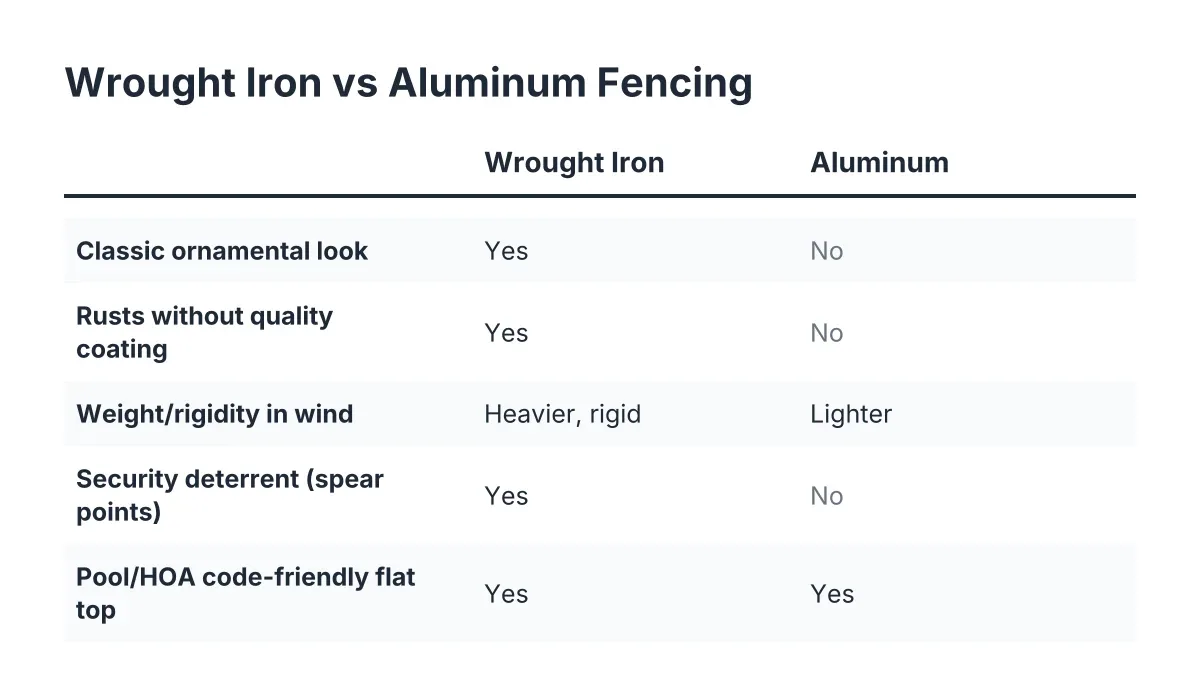
Iron and aluminum panels can look nearly identical from the curb, so the real comparison comes down to strength, weight, rust behavior, and price. Aluminum costs less, never rusts, and installs faster because it is light. Steel ornamental panels are stronger, stiffer, and feel more substantial, but the finish must stay intact to keep rust away.
For Washoe County specifically, two local factors shape this choice. The first is wind. Sparks and Reno get sustained high-desert wind, and an open picket fence sheds wind far better than any solid panel, which is a point in favor of ornamental fencing generally. Between the two metals, steel's extra rigidity means less flex and rattle in gusts. Aluminum panels are engineered to handle wind fine, but on exposed lots the heavier material feels more planted.
The second factor is ground movement. Washoe County winters swing through freeze-thaw cycles that heave posts set poorly. This affects both materials equally, because the failure point is the post footing, not the panel. Alkaline soil in this area also affects how footings should be set. The panel brand matters less than the crew's post-setting habits.
So when does aluminum win? Pool fencing is the strongest case. Aluminum shrugs off splash water and pool chemicals without any coating maintenance, which is why many HOA pool enclosures go aluminum even when the perimeter fencing is steel. Aluminum also makes sense on long perimeter runs where budget per foot matters more than maximum strength.
Steel ornamental panels win on security fencing, front-facing decorative runs, gates that get daily use, and anywhere the fence might take an impact. A steel picket bends; an aluminum picket can snap or tear at the connection. For an HOA weighing a multi-phase replacement, a reasonable split is steel at entrances and street frontage, aluminum at the pool, with powder coat colors matched so the community reads as one design.
DIY or Hire a Crew: An Honest Breakdown
A capable homeowner can install prefabricated ornamental panels on a short, level run. The panels bolt to posts with brackets, and the system is designed for assembly. That is the honest part of the DIY case. Here is the rest of it.
The hard part of any iron fence is not the panels. It is the posts. Every post needs a hole dug to proper depth, set plumb, and footed in concrete that accounts for local soil and frost. Get one post out of line and the panel will not bolt up square; get the footing depth wrong and freeze-thaw will tilt it within a few winters. Rocky ground on older Reno lots can turn an afternoon of digging into a multi-day fight.
Cutting is the other trap. At some point you will face a gap narrower than a stock panel. Cutting a steel panel cleanly takes an angle grinder or a metal-cutting blade, and every cut exposes bare steel that must be primed and sealed or it becomes the first rust point on the fence. People searching how to cut wrought iron fence panels usually discover this after the first cut, not before.
Call a pro rather than DIY when any of these apply:
- The fence line slopes enough that panels need to rake or step
- The run includes a gate, especially a drive gate
- The fence encloses a pool, where code compliance is on you
- You are matching or tying into existing ironwork
- The soil is rocky, or the line crosses old footings from a previous fence
In addition, HOA common-area fencing should not be a DIY conversation at all. Shared perimeter and pool fencing carry liability, code requirements, and the need for phased scheduling across a community. That work belongs with an insured crew that can invoice the association and sequence the job around resident access.
One more limitation worth stating plainly. If an existing iron fence shows rust at the base of multiple pickets or posts, have someone assess it before deciding between fence repair and replacement. Surface rust on a panel face is fixable; rust-through at ground level usually is not, and no guide can make that call from a distance.
Buying Panels and Hiring Smart in Reno and Sparks
Searches for wrought iron fence supplies near me or decorative wrought iron fence panels near me will turn up big-box stock panels and online sellers. Stock panels work for simple projects, but check three things before ordering: whether the panels are rackable for your grade, whether the powder coat is a full coating or a thin paint finish, and whether matching gates and hardware are available in the same line. Mismatched gate hardware is the detail that makes a fence look cheap from the sidewalk.
If you are hiring instead, three questions sort serious installers from the rest:
- How will you set the posts for this soil and our winters? You want to hear specifics about depth, concrete, and footing practice for freeze-thaw and alkaline soil, not a shrug.
- Where will the cut panels go? A crew that plans cut sections into low-visibility areas has done this before.
- Steel or aluminum for my specific use, and why? A fair answer matches the material to the job. Anyone who pushes one material for every situation is selling inventory, not advice.
A fair quote itemizes panels, posts, gates, concrete, and labor separately, and explains what drives each line. Cost on ornamental fencing moves with panel style, height, gate count, grade, soil conditions, and access, so two quotes for "the same fence" can differ for legitimate reasons. Ask what changed between the lines and a straight answer should come back.
Timing matters too. Fencing demand keeps growing nationally; according to IBISWorld, the US fence construction industry reached an estimated $20.0 billion market size in 2026. Locally, that means custom fabrication and non-stock powder coat colors carry lead time, so start conversations before the season you want the fence standing.
Where to Go from Here
You now know more than most buyers walking into this decision. You know ornamental steel is what modern wrought iron fencing actually is, which panel styles exist and what toppers add, how sizing and cut sections work on a real fence line, where custom fabrication earns its cost, and how iron compares to aluminum for Washoe County wind, soil, and winters.
The next step is putting those questions to work on your actual fence line. If you are in Sparks or Reno and want straight answers on panel styles, steel versus aluminum for your lot, or whether an existing iron fence is a repair or a replacement, reach out to Reno Sparks Fence Pros for an estimate. Bring your measurements and your slope, and you will get a plain answer on what fits, what it involves, and what drives the cost.
If you need wrought iron fence installation, Reno Sparks Fence Pros can help.
Prefer to talk it through? Call (775) 369-4729 — a quick call is usually the fastest way to get a straight answer for your situation.