
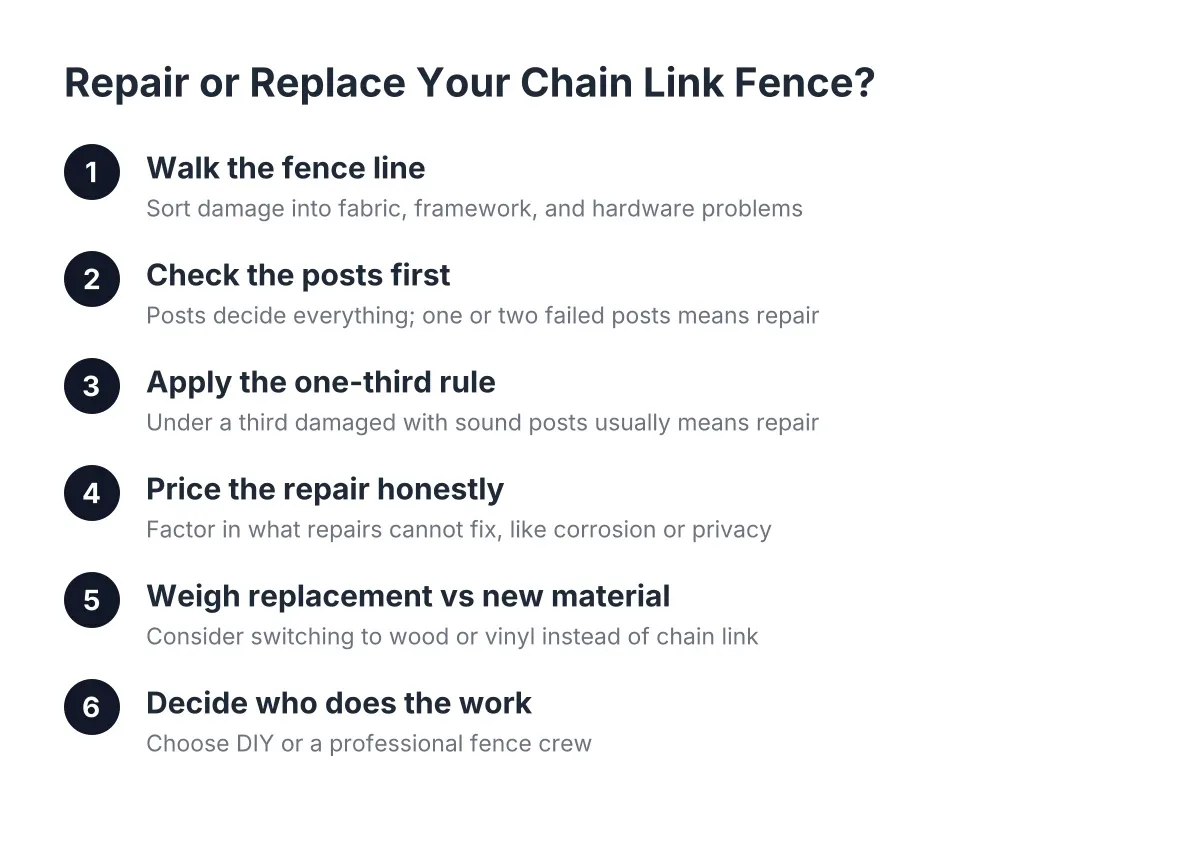
Repair or Replace Your Chain Link Fence? A Step-by-Step Way to Decide
A sagging gate, rusted fabric, or a leaning post forces a choice: should you repair or replace a fence? When it comes to deciding between fence repair and fence replacement, the answer depends on what failed, how much of the fence it affects, and what the fence needs to do for the next ten years. This guide walks through that decision step by step to help you determine whether a repair versus replace fence strategy works best for your situation, so you can judge whether a targeted fence repair makes sense or whether full replacement is the smarter spend. It is written for Sparks and Reno properties, where wind, freeze-thaw winters, and alkaline soil all play a role in how chain link fails.
Chain link remains one of the most common fence types in the country. According to Global Growth Insights, chain link fencing accounts for nearly 34% of total fencing demand in the United States. That popularity means parts are easy to source, which matters for the repair side of this decision.
Step 1: Walk the Fence Line and Sort Damage Into Three Buckets
Start with a slow walk along the full fence line. Push on each post. Look at the fabric, the top rail, the tension bands, and the gates. Sort every problem you find into one of three buckets:
- Fabric problems: bent mesh, holes, rust spots, fabric pulled loose from posts or rails
- Framework problems: bent or leaning posts, a bent or separated top rail, loose or missing fence ties
- Hardware problems: sagging gates, worn hinges, broken latches, loose tension bands
This sorting matters because each bucket points toward a different answer. Fabric and hardware problems lean toward repair. Widespread framework problems lean toward replacement. Write down how many posts, how many feet of fabric, and how many gates are affected. You will use those counts in Step 3.
Step 2: Check the Posts First, Because Posts Decide Everything
Posts are the structure. Fabric, rails, and gates all hang off them. If the posts are plumb and solid in their concrete footings, nearly everything else on a chain link fence can be repaired at reasonable cost. If multiple posts have failed, replacement starts to win.
In Washoe County, posts fail in a few predictable ways. Freeze-thaw cycles can heave shallow footings and tilt posts over several winters. High-desert wind loads work posts back and forth until the concrete cracks or the post bends at ground level. Alkaline soil accelerates corrosion on older galvanized posts right at the soil line, which is where most of them snap.
Grab each post and push hard. A post that moves in its footing, shows rust-through at the base, or leans more than a few degrees is a failed post. One or two failed posts in an otherwise sound fence is a repair job. Knowing how to replace a chain link fence post is standard work for any crew that does chain link fence repair; the old post comes out or gets cut off, and a new one gets set and tied back in.
Step 3: Apply the One-Third Rule to Decide Whether to Repair or Replace Your Fence
When should you repair rather than replace a chain link fence? A useful working rule: if less than about one third of the fence needs work, and the posts are mostly sound, repair is usually the better value. If damage touches more than a third of the posts or fabric, replacement often costs less per year of remaining life than piecemeal fixes.
Here is why the math tilts that way. Repairs carry fixed overhead; a crew has to show up, mobilize, and match materials whether they fix ten feet or a hundred. Stacking three or four separate repair visits over a few years can approach the cost of a new fence without delivering a new fence. Replacement resets the clock on every component at once.
Apply your counts from Step 1. Say a homeowner in a Spanish Springs subdivision has a 150-foot chain link perimeter with two leaning posts, one bent top rail section, and a gate that drags. In that scenario, framework damage affects maybe 20 feet of a 150-foot run. That is a clear repair. However, suppose the same fence had eight corroded posts and rust across half the fabric. That fence is at end of life, and repair money would be chasing a moving target.
Step 4: Price the Repair Honestly, Including What Repairs Cannot Fix
Before committing to repair, list what a repair visit would include and what it would leave untouched. Common chain link repairs, roughly from least to most involved:
- Re-tying loose fabric with new fence ties, which come in different lengths matched to the pipe diameter
- Replacing a chain link fence top rail section that is bent or separated
- Splicing in new fabric to replace a damaged chain link fence section
- Adjusting or replacing a chain link fence gate, hinges, and latch
- Setting one or more new posts and re-tensioning the fabric to them
Cost factors, not fixed prices, drive each of these: linear feet affected, post count, fabric gauge and coating, gate hardware, and access to the fence line. A fence crammed against a neighbor's fence or wrapped around mature trees takes longer to work on than an open run.
Also be honest about what repair cannot fix. Repair does not reverse widespread corrosion, and it does not raise a fence that is the wrong height for your needs. Chain link also offers no privacy. If you bought a new build on a bare lot and want screening from the neighbors, repairing an inherited chain link fence keeps a fence you may not actually want.
Step 5: Weigh Replacing Your Fence Against Switching Materials Entirely
Replacement opens a second question: replace with chain link again, or switch materials? Many homeowners searching how to replace a chain link fence with wood, or how to replace chain link fence with vinyl, are really asking whether the old fence still fits the property.
Chain link earns its keep for pet containment, open sight lines, and low maintenance. It handles Sparks wind well because air passes through the mesh instead of loading the fence like a sail. A solid wood fence or vinyl fence takes that full wind load, which means deeper footings and closer post spacing matter more with those materials.
For the HOA angle, check your governing documents before you spend anything. Some planned communities in Sparks and Spanish Springs restrict chain link on street-facing lot lines, or require specific colors, heights, or styles such as wood or wrought iron. Nothing wastes money faster than repairing a fence your HOA later flags for removal, or replacing it with a material the architectural committee rejects. Submit the style, height, and material in writing first; one clean submission beats a rejection and resubmission cycle.
If the existing chain link is in a compliant location, a black vinyl-coated replacement often reads cleaner than bare galvanized and gets easier HOA approval. That is a replacement-stage decision, so raise it before fabric is ordered.
Step 6: Decide Who Does the Work
A fabric re-tie or a latch swap is a reasonable weekend project. Post replacement, fabric tensioning, and full chain link fence installation are harder than they look. Fabric must be stretched with consistent tension between terminal posts, or it sags within a season. Footings need the right depth for frost and wind, and tie spacing has to match the framework.
Therefore, match the job to the skill. If your Step 1 walk found only fabric and hardware issues, DIY is viable. If it found failed posts, bent rails, or more than a third of the fence in trouble, searching for chain link fence installation near me and getting a crew that works in Sparks and Reno soil conditions will likely save you a redo. A local fence company can also tell you when an interim repair preserves value, for example setting a new post into an existing sound footing instead of demolishing concrete.
One honest limitation: no article can inspect your footings. If a post wobbles and you cannot tell whether the concrete or the post failed, have a professional look before you buy materials. The fix differs, and guessing wrong wastes the repair budget.
A Quick Reference for the Repair-Versus-Replace Chain Link Call
Use this summary when you finish your walk-through:
- Repair when posts are sound, damage covers less than a third of the run, and chain link still suits the property
- Replace with chain link when posts have widely failed but you still want visibility, airflow, and low upkeep
- Replace with another material when you need privacy, your HOA restricts chain link, or you are fencing a bare new-build lot from scratch
The repair-or-replace chain link decision comes down to posts, proportion, and purpose. Check the posts first, count the damage against the one-third rule, and confirm the fence still does the job you need in 2026 and beyond. Get those three answers right and the rest of the project, whether it is a half-day repair or a full perimeter build, follows cleanly.
If you need chain link fence repair, Reno Sparks Fence Pros can help.
Prefer to talk it through? Call (775) 369-4729 — a quick call is usually the fastest way to get a straight answer for your situation.