
Horizontal Wood Fence Boards: Width, Spacing, and Gap Sizes Explained
If you have already decided on a horizontal fence, the next decisions are all about the boards. The width of your horizontal wood fence boards, the gap between them, and how those choices carry through to the gate will shape how the fence looks, how private it feels, and whether it actually contains a dog or keeps a toddler away from the pool. Understanding proper horizontal fence board spacing is essential to getting the design and function you want. This guide walks through those decisions step by step, in the order a crew in Sparks or Reno would actually make them.
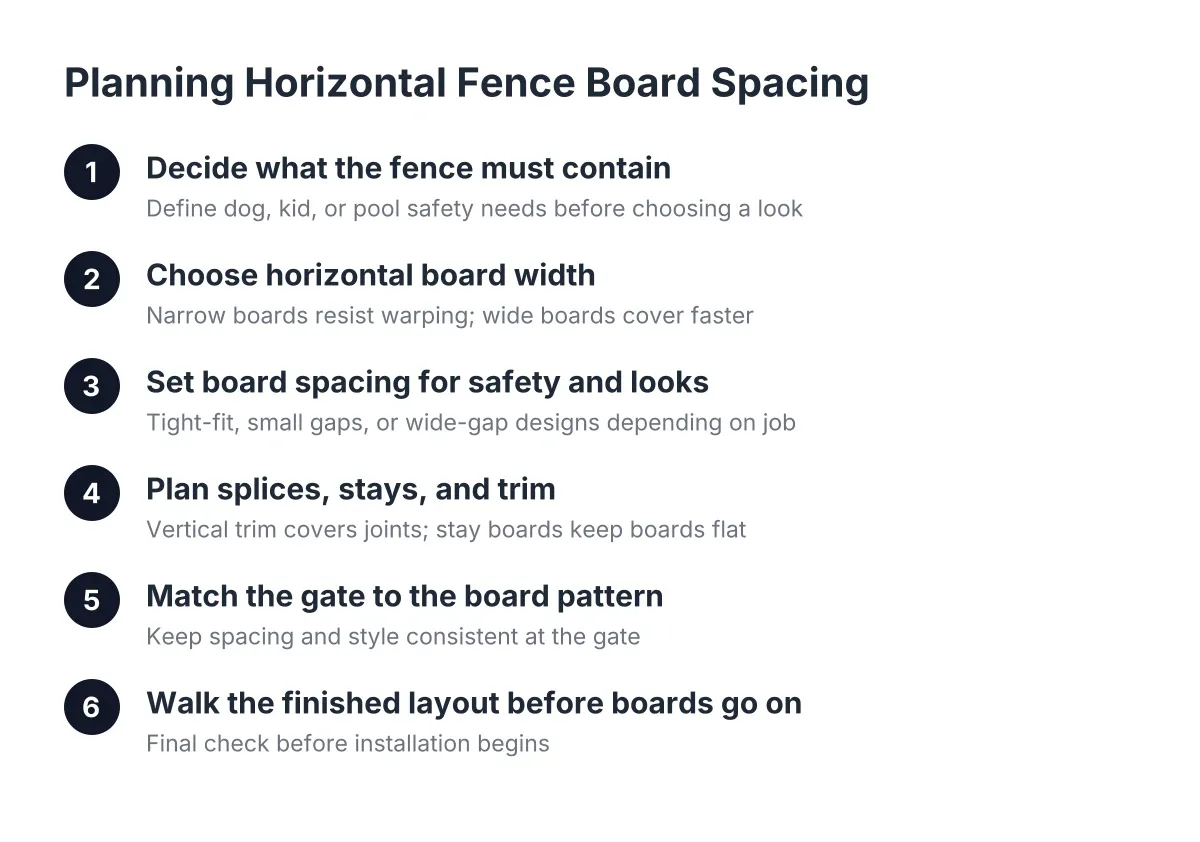
Board layout is not just a style call. A gap size that looks great on Pinterest can be a ladder for a climbing kid or a squeeze point for a small dog. Work through these steps before your fence installation starts, and you will get a fence that looks modern and does its safety job.
Step 1: Decide What the Fence Has to Contain Before You Pick a Look
Start with the job, not the photo. A wood horizontal fence built for privacy and one built for pet or pool safety can use the same posts and rails, but the board spacing rules are different.
If the fence is keeping a dog in the yard, horizontal boards with wide gaps become a problem twice over. Small dogs push through gaps, and larger dogs use the boards as steps. For pool areas, horizontal designs need extra attention; evenly spaced boards can act like a ladder for a climbing child, which is exactly what pool barrier rules try to prevent.
For example, suppose a family in a newer Sparks subdivision has a toddler, a terrier, and a backyard pool. In that scenario, the pool-side fence sections should run tight, with no climbable gaps, while a decorative section along the front yard could use wider spacing for an open look. One fence line, two spacing plans.
Write down three things before moving on:
- Who or what the fence must contain or exclude (dog size, kid age, pool access)
- Which sections need full privacy versus airflow or a view
- Any HOA or code requirements, since Washoe County pool barriers and many HOA guidelines set minimums for height and gaps
If a pool is involved, have someone who knows local barrier requirements review the plan. Spacing that looks safe can still fail an inspection.
Step 2: Choose the Width of Your Horizontal Wood Fence Boards
Board width sets the whole character of the fence. Narrow boards read busy and modern, with lots of horizontal lines. Wide boards read calm and clean, with fewer lines across the face. Many builds mix widths in a repeating pattern, which hides small milling variations and gives the fence a custom look without custom material.
There are practical trade-offs behind the style choice. Wider boards show cupping and warping more than narrow ones, especially through Washoe County freeze-thaw winters and dry summers. Narrow boards resist cupping better but mean more pieces to fasten, which adds labor.
Keep these points in mind:
- Narrower boards handle high-desert moisture swings better and warp less
- Wider boards cover the fence faster but need high-quality, dry lumber to stay flat
- Mixed-width patterns forgive imperfect boards and look intentional
- Every board needs two fasteners per post to resist twisting in Sparks wind exposure
One more structural point. Horizontal designs put the board span between posts, so long boards with no mid-support will bow in and out over time. A vertical stay board centered between posts holds the horizontal pickets flat. Plan for it now, because it affects the material count in the next step.
Step 3: Setting Horizontal Fence Board Spacing for Safety and Aesthetics
Gap size is the single biggest decision for a pet and pool safety buyer. You have three basic options with horizontal fence boards, and each one serves a different job.
Tight-fit boards for privacy and containment
Boards installed edge to edge give full privacy and remove climbing footholds. This is the right call for pool enclosures and for yards with escape-artist dogs. One caution: wood shrinks as it dries, so boards installed tight will open slight gaps over the first year. In the high desert around Reno, that shrinkage is real, and a good crew accounts for lumber moisture when setting the layout.
A horizontal wood fence with gaps for airflow and light
Small, even gaps give the fence a lighter look, let wind pass through, and reduce the sail effect on exposed Sparks lots. Wind load matters here; a solid six-foot fence on an open lot takes serious pressure in a gusty afternoon. However, keep gaps small enough that a dog cannot get a paw or snout through, and never use open spacing on a pool barrier section where gaps could become toeholds. Proper horizontal fence board spacing prevents escape routes while maintaining the open aesthetic you want.
Wide-gap or semi-open designs
Wide gaps create a slatted, open style that works for front yards, courtyard dividers, and sections where you want a view. For a containment fence, treat wide gaps as decoration only. A determined dog or a curious kid will defeat them.
A consistent gap depends on consistent technique. Crews cut spacer blocks and use them at every post so the gap never drifts. If you are comparing bids, ask how the installer holds gap consistency over a long run; the answer tells you a lot about the finished look.
Step 4: Plan the Splices, Stays, and Trim That Keep Horizontal Boards Looking Sharp
Horizontal boards have to end somewhere, and where they end is where cheap builds show. Boards splice at posts, and a run of raw butt joints down the fence line looks unfinished. A vertical trim strip over each splice point covers the joints and gives the fence crisp, evenly spaced vertical breaks.
In addition, confirm the stay boards from Step 2 are in the plan. Between every pair of posts, a vertical stay fastened to the back of the boards keeps them from bowing. Skip it, and a straight fence in May looks wavy by the following spring.
Post layout matters too. Post spacing should be measured center to center, not edge to edge, so every bay of horizontal boards comes out the same length. On a sloped lot, which is common on older ranch-style properties around Reno, post spacing often has to tighten so boards seat correctly as the fence steps or rakes with the grade. Where a run will not divide evenly, the shortened bay belongs in the least visible corner of the yard, with full bays facing the street and patio.
Expect this style to cost more than a standard vertical wood fence. Horizontal builds need straighter lumber, more fasteners, stays, trim, and more layout time, so the price gap is real material and labor, not markup. According to Angi, wood fences last about 15 years on average and up to 20, so board quality decisions you make now pay off across that whole span.
Step 5: Match the Horizontal Wood Fence Gate to the Board Pattern
The gate is where the pattern either carries through or falls apart. A horizontal wood fence gate should continue the exact board widths and gap sizes of the fence, with the boards aligning across the gate when it is closed. That alignment takes a rigid gate frame, because horizontal boards alone will sag into a parallelogram.
For pet and pool safety buyers, gate hardware matters more than gate looks:
- Build the gate on a steel or well-braced wood frame so the pattern stays square
- For pool access, use self-closing hinges and a self-latching latch mounted at the height local barrier rules require
- Set gate gaps tighter than fence gaps, since the latch side and bottom edge are where pets test first
- Swing pool gates outward, away from the pool, which most barrier codes require
Say a property manager oversees a Reno community pool with a horizontal perimeter fence. In that scenario, the gate is the compliance point an inspector checks first: self-closing, self-latching, and no gap pattern a child can climb. Getting the gate right protects the association, not just the look.
Step 6: Walk the Finished Layout Before Boards Go On
Once posts are set and before boards go up, do a walkthrough. Check post spacing against the plan, confirm where stays and trim strips land, and verify the gate opening. This is the last cheap moment to change anything; moving a set post after concrete cures is a different job entirely.
Then, after installation, test the fence the way your dog or kid will. Push on mid-span boards, check gaps at grade where dogs dig, and cycle the gate latch twenty times. A horizontal fence built with the right board width, honest gap sizing, and a gate that latches itself is a fence you stop thinking about, which is the whole point. For pool barriers specifically, confirm final compliance with whoever handles inspections in your area rather than relying on a visual check alone.
If you need horizontal wood fence installation, Reno Sparks Fence Pros can help.
Prefer to talk it through? Call (775) 369-4729 — a quick call is usually the fastest way to get a straight answer for your situation.