
Horizontal Wood Fence Gaps: How to Balance Privacy, Airflow, and Looks
You picked a horizontal fence. Now you have one decision left that shapes everything else: the size of horizontal fence gaps. Open spacing between boards changes how private the yard feels, how the fence handles Washoe County wind, and whether a determined dog or a curious toddler can get a paw or foot into the fence. This guide walks you through the decision step by step, so the fence you build actually does the job you bought it for.
Gapped horizontal fences are popular in Reno and Sparks for good reason. They look modern, they let light through, and they shed wind better than a solid wall. But a gap that looks great on a design blog can be a problem on a yard built to contain a beagle. Here is how to get it right.
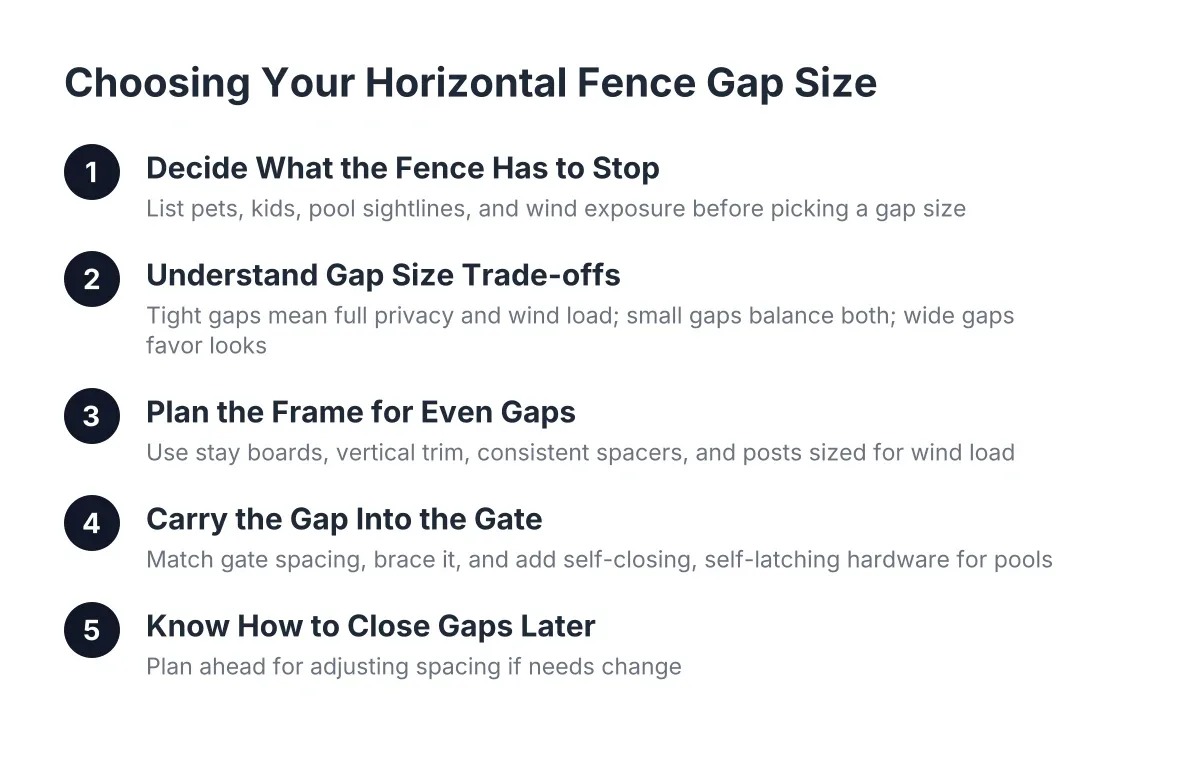
Step 1: Decide What the Fence Has to Stop
Before you talk spacing, write down what the fence must contain or block. Everything else follows from this list.
For a pet and pool safety buyer, the list usually looks like this:
- A dog that digs, squeezes, or climbs
- A toddler who treats any horizontal board like a ladder rung
- Line of sight into a pool area or play area
- Wind exposure on an open Sparks lot
That last point matters more than most homeowners expect. Horizontal boards with gaps act like a ladder for kids. Vertical fences give small feet nothing to stand on; a gapped horizontal fence gives them a rung every few inches. If the fence separates a child from a pool, lean toward tight or zero gaps, a taller build, and hardware a kid cannot reach. On pool safety specifically, isolation fencing that encloses only the pool is more protective than three-sided fencing, with an odds ratio of 0.17 for drowning risk compared to three-sided fencing, according to Cochrane. A four-sided enclosure with a self-closing, self-latching gate is the standard to aim for, and your local building department has the final say on code.
If the fence only needs to contain a large dog and mark the property line, you have far more freedom with spacing.
Step 2: Understanding Horizontal Fence Gap Size for Privacy, Airflow, and Safety
There is no single right gap. There is a right gap for your yard. Think of it as three zones.
Tight or no gaps: full privacy, full wind load
A horizontal wood fence with no gaps gives you a solid screen. Nobody sees the pool, the dog cannot see the mail carrier, and the yard feels enclosed. The trade-off is wind. A solid fence catches wind like a sail, and in high-desert gusts a solid panel takes more force than an open one. A fence that blocks wind almost completely can be more prone to blowing over than one that lets air pass through. In Sparks and Reno, that means deeper posts, closer post spacing, and solid framing if you go this route.
Small gaps: the working compromise
A narrow gap between horizontal fence boards keeps most sightlines blocked while letting wind bleed through. This is the sweet spot for many Reno yards. You keep a private feel, the boards have room to swell and shrink through freeze-thaw winters, and the fence sheds gusts instead of fighting them. When considering the right horizontal fence gap size for pet containment, keep the gap smaller than anything your animal can wedge a nose or paw into. A small dog or a persistent terrier changes the math; what contains a lab will not contain a chihuahua.
Wide gaps: the design statement
A horizontal privacy fence with gaps wide enough to see through is really a screen, not a privacy fence. It looks sharp along a front yard or around a patio. It is the wrong choice around a pool with a toddler in the house, and it will not hold a cat or small dog. Use wide spacing where looks matter and containment does not.
Step 3: Plan the Frame So the Horizontal Fence Gap Size Stays Even
Horizontal wood fence gaps only look good if they stay consistent. Wood moves. Long horizontal boards bow in and out over time unless the frame supports them, and a bowed board turns a clean quarter-inch gap into a wavy mess.
Plan for these framing details:
- A vertical stay board mid-span. A horizontal cedar design needs a vertical stay between posts to keep long boards from bowing. Without it, boards flex, gaps drift, and the fence looks tired within a few seasons.
- Vertical trim over splice points. Where board ends meet on a post, a vertical trim strip covers the seams and keeps the face clean. It also hides minor cutting variation.
- Consistent spacers during install. A good crew cuts spacer blocks and uses them on every course so the gap reads as one straight line from end to end.
- Posts set for the load. Alkaline soil around Washoe County is hard on posts, and wind load depends on how open the fence is. Solid designs need stouter post work than gapped ones.
Expect a wood horizontal fence to cost more in labor and material than a standard vertical privacy fence. The extra framing, trim, and spacing work is real, not markup. Custom styles genuinely take more boards and more hours.
Step 4: Carry the Gap Decision Into the Gate
The gate is where pet and pool fences fail. A fence can be perfect and still leak at a gate that sags, swings open, or latches where a four-year-old can reach it.
Match the gate design to the fence, then upgrade the hardware:
- Build the gate with the same board spacing so the fence reads as one piece.
- Add a diagonal brace or steel frame; horizontal boards alone will sag.
- For pool areas, use a self-closing hinge and a self-latching latch mounted high, out of a child's reach. Check your local code before the build, not after.
- For dog yards, choose a latch that cannot be nosed open and check the gap under the gate; that is the first place a digger goes.
Here is an illustrative scenario. Say a homeowner in Sparks builds a gapped horizontal fence around the backyard, then adds a new puppy six months later. The fence holds fine, but the gate was hung with a standard gravity latch and a two-inch gap at the bottom. The puppy learns to flip the latch in a week. In that scenario, the fix is hardware and a kick board under the gate, not a new fence. Plan the gate for your worst-case escape artist from day one.
Step 5: Know How to Close Horizontal Wood Fence Gaps Later
Maybe you built, or inherited, a gapped fence and your needs changed. A new dog, a new pool, a toddler who just learned to climb. You do not always need a rebuild.
Common ways to cover gaps in a wood fence without replacing it:
- Add backer boards. Fasten boards to the back side, offset to cover each gap, shadow-box style. Both sides still look finished.
- Add a kick board at grade. A horizontal board along the bottom closes the gap dogs dig under first.
- Face one section solid. Around a pool, you can tighten only the enclosure area and leave the decorative spacing elsewhere on the lot.
- Add trim for looks. A face trim board adds depth and can mask uneven gaps on an aging fence.
In addition, aging matters here. Wood fences last about 15 years on average, up to 20 depending on wood type, climate, and pests, according to Angi. If your fence is past year eight and boards are cupping or posts are loose, closing gaps may be the moment to repair the structure too. Angi also reports wood fence repair typically runs $300 to $925, with average costs around $600, so catching damage early beats waiting for a wind event to take a section down.
One honest limitation: if posts are rotted at grade or the fence leans after every storm, gap fixes are cosmetic. Have a local fence company look at the structure before you spend money on boards. And for any pool enclosure, confirm height, gap, and latch requirements with your building department; pool code is not a place to guess.
The Short Version
Horizontal wood fence gaps are a trade-off dial, not a style default. Turn it toward closed for pool safety, small kids, and small dogs. Turn it toward open for airflow, wind resistance, and a modern look where containment does not matter. Frame the fence so gaps stay straight, build the gate to the same standard with better hardware, and know that a gapped fence can be tightened later if life changes. Get those steps right and the fence stops being something you worry about every time the back door opens.
If you need horizontal wood fence installation, Reno Sparks Fence Pros can help.
Prefer to talk it through? Call (775) 369-4729 — a quick call is usually the fastest way to get a straight answer for your situation.