
Wood Fence Maintenance Schedule for Sparks, NV: Season-by-Season Steps
A wood fence maintenance schedule is the cheapest insurance you can buy against the wind that rips through Sparks, NV every spring. High-desert gusts find every loose board, every soft post, and every rusted fastener, and they do it a few sections at a time until a whole run goes down in one storm. This guide walks through a season-by-season schedule, step by step, so you catch the small problems before they become an insurance claim, a liability question, or a tenant complaint.
This matters whether you own one home or ten rental units across Sparks, Reno, and Sun Valley. According to Angi, wood fences last about 15 years on average, up to 20 years, depending on wood type, climate, and pest exposure. The difference between 10 years and 20 is mostly maintenance. Angi also reports wood fence repair costs range from $300 to $925, with an average around $600, so catching damage early is far cheaper than rebuilding sections after a windstorm flattens them.
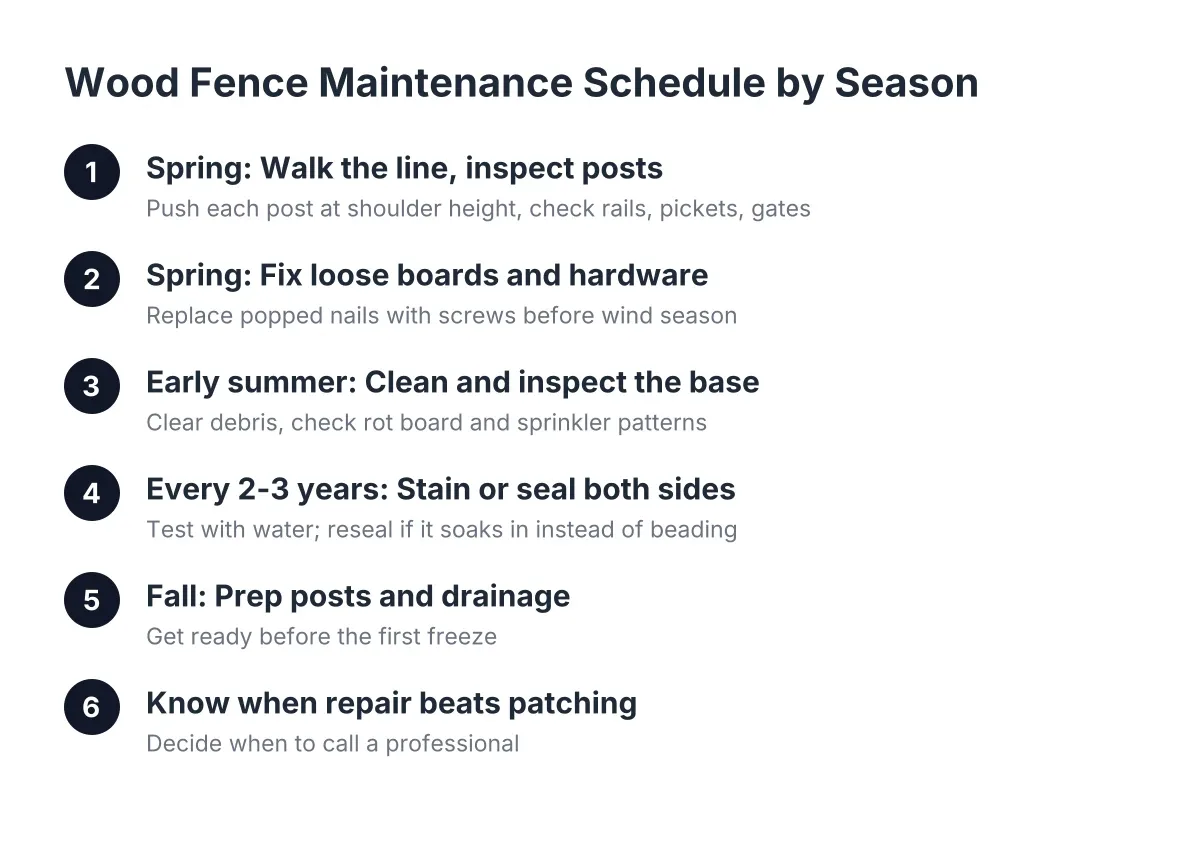
Here is the schedule, broken into steps you can follow through the year.
Spring Wood Fence Maintenance Schedule: Walk the Fence Line and Inspect Each Post
Start in March or April, after the last hard freezes but before the strong spring winds peak. Walk the full fence line and push firmly on each post at shoulder height. A solid post barely moves. A post that rocks in its footing has a problem below grade, and that problem is where wind failures start.
Posts fail first in Washoe County for two reasons. First, freeze-thaw cycles through the winter open gaps around the footing and let water sit against the wood. Second, our alkaline soil and pooled moisture rot the post right at ground level, even when the boards above look freshly painted. A fence can look great and still be one gust away from going down.
While you walk, check these items:
- Posts that rock, lean, or sound hollow when knocked at ground level
- Rails pulling away from posts, especially on the windward side
- Pickets that are cracked, cupped, or missing fasteners
- Gates that drag, sag, or no longer latch
- Soil or mulch piled against the bottom of the boards
Note every problem on your phone with a photo and a location. For a landlord with three properties, this 20-minute walk per unit builds a punch list you can hand to one local fence company instead of making three emergency calls in May.
Wood Fence Maintenance Schedule: Fix Loose Boards and Hardware Before Wind Season
Spring winds in Sparks and Reno do not knock down tight fences nearly as often as they finish off loose ones. A picket with one popped nail becomes a sail. It works the next board loose, then the rail, and a 40 mph gust takes out the section. Therefore, fasteners come before anything cosmetic on the schedule.
Replace popped nails with exterior-grade screws, which hold far better in wood that has already loosened. Refasten any rail that has pulled away from its post bracket. Tighten gate hinges and latches, and adjust the gate so it closes without dragging. If a rail end has rotted where it meets the post, that section needs wood fence repair beyond a screw; a repair crew can sister or replace the rail before the whole panel racks out of square.
This is also the step where documentation pays off if you are dealing with insurance. Suppose a March storm drops two sections of your fence and a tree limb crushes a gate. Your spring photos from the prior year show the fence was sound and maintained. An itemized repair estimate, broken out by posts, rails, pickets, and gate hardware, gives the adjuster line items that match how they evaluate claims. A reputable fence repair company can write the estimate that way; adjusters respond better to itemized scopes than to one lump-sum number.
Clean and Inspect the Base of the Fence in Early Summer
Early summer is when you deal with everything touching the bottom of your fence. Pull soil, mulch, weeds, and stacked debris at least a few inches away from the boards. Wood that touches wet ground wicks moisture up into the pickets, and that is how rot climbs a fence from the bottom.
In addition, look hard at the bottom edge of the boards. If your fence has a rot board, a sacrificial pressure-treated board running along the ground under the pickets, check whether it is doing its job. A rot board absorbs the ground contact so the fence boards above stay dry. If yours is crumbling, replacing it is a small job that protects every picket above it. If your fence never had one, adding a pressure-treated rot board during the next repair visit is one of the better longevity upgrades for a cedar fence in this climate.
Check sprinkler patterns too. A sprinkler head that soaks the same fence section every morning will rot that section years ahead of the rest. Adjust the head or add a deflector.
Stain or Seal on a Two-to-Three-Year Cycle, Both Sides
High-desert sun is as hard on wood as winter moisture. UV exposure grays the surface, opens checks in the grain, and lets water in. A penetrating stain or sealer closes that door. Most fences in the Sparks and Reno area need a new coat every two to three years; test yours by sprinkling water on a board. If the water soaks in instead of beading, the fence is due.
Stain both sides. A fence sealed on the street side and bare on the yard side still pulls moisture through the unsealed face, and the boards cup and split from the inside out. Staining both faces takes more product and time, but it meaningfully extends the life of the fence and the return on what you spent building it.
For a landlord, this is the step worth batching. Say you own four units in Sparks and Sun Valley; staining all four fences in one scheduled visit costs less per property than four separate trips, and it puts every fence on the same future schedule. One vendor, one invoice, one calendar reminder.
Prep Posts and Drainage Before the First Freeze
Fall is the post season on any wood fence maintenance schedule in Washoe County. Water that sits around a footing in October becomes ice in December, and ice expands with enough force to crack concrete and heave posts. Before the first hard freeze, walk the line again and fix drainage.
Work through this list in October:
- Regrade low spots so water drains away from footings instead of pooling against them.
- Caulk or seal the gap where each post meets its concrete footing if water can collect there.
- Re-check any post that moved in spring; a marginal post in October is a failed post by March.
- Clear leaves and debris from fence corners where snow and ice will sit longest.
One thing many homeowners get wrong: concrete around a post is not automatically protection. Concrete that traps water against the wood can speed up rot compared to a footing that drains. If a post has rotted at grade but the concrete footing is sound, an interim post repair that reuses the footing can keep the fence standing now, and that spend is not wasted, because the section is already staged for a future rebuild with steel posts.
A Realistic Year on This Maintenance Schedule
To make the schedule concrete, suppose a homeowner in Spanish Springs follows it for one year. In April, the walk-through finds two rocking posts and a sagging gate. Fixing those in May costs a few hundred dollars, framed here as an illustrative estimate, not a quote. In June, they pull mulch off the fence base and adjust one sprinkler. The fence skips staining this year because water still beads on the boards. In October, they regrade one low corner. When a 50 mph November gust hits, the fence holds, and there is no claim to file, no adjuster to chase, and no half-down fence creating a liability question for weeks.
Know When Repair Beats Patching, and Who Should Do It
Follow the schedule and most fixes stay small. However, some situations call for a professional crew rather than another weekend patch:
- Three or more posts loose in the same run, which usually signals footing or soil problems
- Rot you can push a screwdriver into at the base of multiple posts
- A fence section down from storm or vehicle damage, especially if insurance is involved
- A gate that keeps sagging after repeated hinge adjustments, often a post problem in disguise
Insurance situations deserve their own note. If wind or a fallen tree took out part of your fence, get the damage documented with photos before anything is moved, and ask the repair company for an itemized estimate that separates materials, labor, post count, and linear footage of affected sections. That format is what adjusters compare against their own pricing. Most claims work is between you and your insurer, so confirm with your carrier before authorizing repairs if you expect the claim to cover them; starting work before approval is a common and avoidable dispute.
There is a trade-off to be honest about. A wood fence on a strict maintenance schedule still will not outlast vinyl or wrought iron, and in a severe windstorm even a well-kept fence can lose sections. The schedule does not make wood invincible; it makes failures rare, small, and cheap instead of sudden and expensive.
When you search for fence repair near me within 5 mi after a storm, you want a crew that already knows how Sparks wind, Washoe County freeze-thaw, and alkaline soil wreck fences, because the fix has to account for all three. A local fence company that repairs fences here every week can tell you in one visit which posts will survive another winter and which will not. Put the walk-throughs on your calendar now: one in spring, one in fall, stain check every summer. That is the whole wood fence maintenance schedule, and it is the difference between a fence that lasts and a fence that becomes your next claim.
If you need fence installation in Sparks, NV, Reno Sparks Fence Pros can help.
Prefer to talk it through? Call (775) 369-4729 — a quick call is usually the fastest way to get a straight answer for your situation.